The Weekly Scan for week of 29 June ’26
Horizon scan · Responsible AI for charities
The Weekly Scan
by Curia AI · Week of 29 June 2026
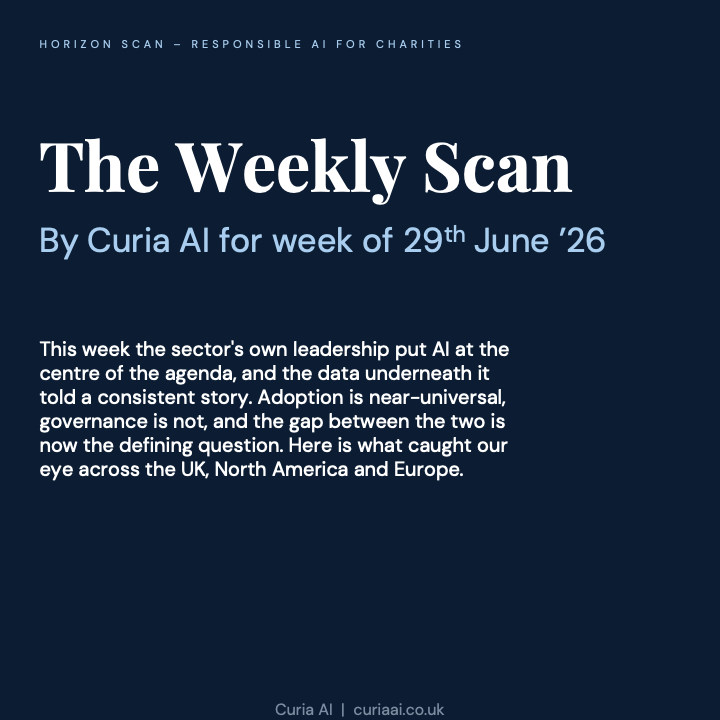
This week the sector’s own leadership put AI at the centre of the agenda, and the data underneath it told a consistent story. Adoption is near-universal, governance is not, and the gap between the two is now the defining question. Here is what caught our eye across the UK, North America and Europe.
NCVO’s incoming chair: AI can strengthen civil society if capability is shared
NCVO’s chair designate, Jude Sheeran, writing as the umbrella body published its new strategy, argues AI is already reshaping how organisations think, decide and engage, and that the question is no longer whether AI will shape civil society’s future. His hope is that larger charities investing in AI now will transfer that capability across the sector, with NCVO convening the exchange.
AI use reaches 91% of charities while only 30% have a policy
Blackbaud’s Status of UK Fundraising 2026 report, surveying 380 charity staff, found AI use has risen to 91% of charities, up from 57% in 2023, while only 30% have an AI policy in place. Ethical concerns lead the barriers list at 61%, and the two resources charities most want are guidance on ethical AI use, cited by 65%, and case studies of successful implementation, cited by 56%.
National Lottery Community Fund puts £3m behind community-led AI
The National Lottery Community Fund, with UK Community Foundations and CAST, is funding a UK-wide “AI pulse network” of 50 community organisations alongside community-led development of AI tools rooted in local needs, with the first grants landing this autumn. Chief executive David Knott framed it around a “wisdom gap”, the sense that AI is advancing faster than society’s ability to understand and shape it, and that communities “cannot sit at the edge of these systems, they have to help shape them.”
From North America, 92% adoption against 7% impact
One of the more striking datasets of the year finds that 92% of nonprofits now use AI while only 7% report major improvements in organisational capability. Some 81% describe their use as individual and ad hoc, only 4% have documented, repeatable workflows, and nearly half have no formal AI governance policy at all.
From Europe, EU AI Act enforcement powers arrive in August
This is a useful checkpoint as the EU AI Act moves from preparation to enforcement, with national regulators gaining full powers to inspect, audit and fine from August 2026. Most charities fall outside the high-risk bracket, yet the Act reaches any AI system used in the EU regardless of where the organisation is based, and organisations making decisions about health, education or service eligibility will need to look more closely. The practical ask is to know when AI is being used, to document it, and to show where humans oversee decisions.
Trust is the asset at stake
Charity Excellence’s Future Charity Report found 76% of UK charities using AI while only 2% were doing so at a strategic level, with boards largely unsighted. Operational safeguards such as data protection and human review are improving faster than strategic governance, which suggests adoption is being driven from the ground up. As founder Ian McLintock puts it, “Trust is the charity sector’s greatest asset, and in an AI-enabled world we cannot afford to take it for granted.”
About this scan
The Weekly Scan is Curia AI’s horizon-scan of responsible AI, governance and trust across the UK, North American and European charity sectors. Curia AI helps charities scale AI responsibly, without losing the trust they depend on.
Take the AI governance maturity assessment · Download the regulatory guide · Get in touch
This news report has been brought to you with the assistance of Claude Opus 4.8.